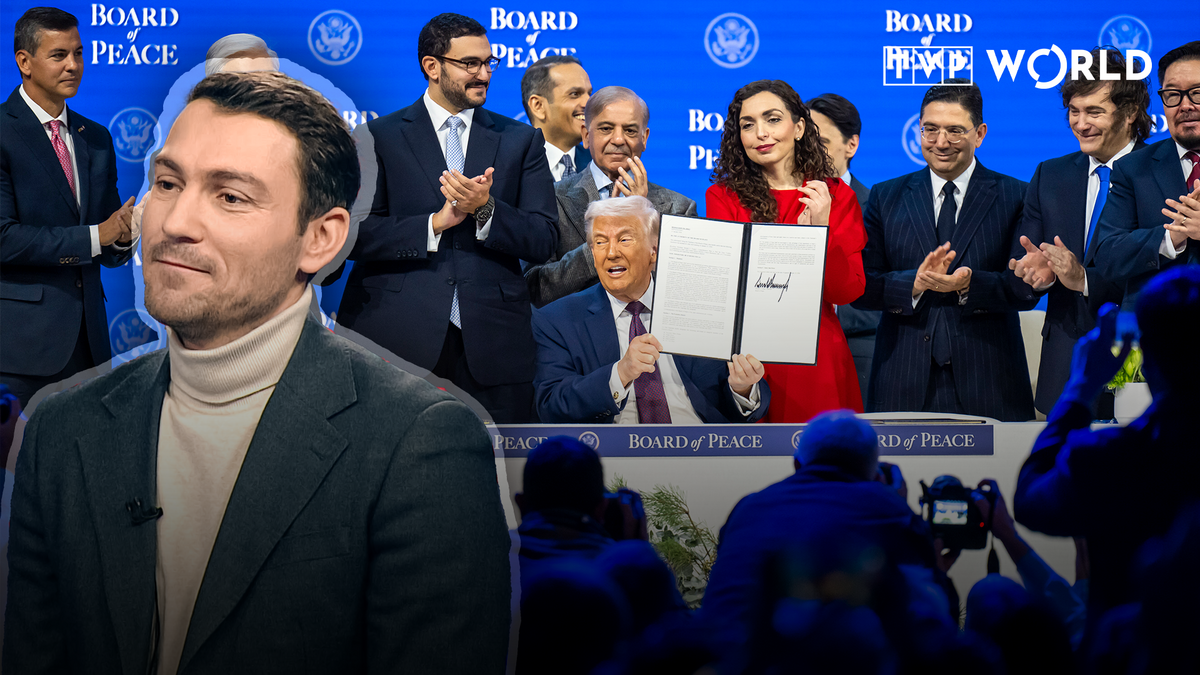
Donald Trump’s claim that the world is now “richer, safer, and more peaceful” took center stage at the World Economic Forum in Davos, where the U.S. president unveiled his proposed “Board of Peace”—a new American-led diplomatic initiative that has quickly exposed deep divisions across Central and Eastern Europe. The proposal was dissected on World Talks by former Romanian diplomat Eusebiu Slavitescu, who questioned both the legitimacy and the design of the initiative, warning that it risks undermining existing international institutions while concentrating power in Washington. A price tag and a power imbalance Hungary and Bulgaria have already signed on, while Albania and Kosovo see participation as a way to raise their international profile. Poland, Romania, and Moldova, however, remain cautious. Critics argue that the board’s draft text grants sweeping decision-making authority to the U.S. president, lacks clear voting rules, and requires a reported €1 billion financial contribution—an amount Slavitescu described as “a lot of money” for countries facing economic strain. “The main issue is the text,” Slavitescu said, arguing that the structure resembles a UN-style body without the safeguards that give such institutions legitimacy. He added that the proposal could weaken European cohesion at a time when unity is already under strain. Europe’s dilemma While Slavitescu acknowledged Trump’s argument that the global security environment has improved—pointing to a weakened Iran and Venezuela’s isolation—he warned that the broader international system is deteriorating. In his view, Washington is eroding the liberal order it once championed, risking long-term instability. For Romania, the answer is likely no. Slavitescu said Bucharest can neither afford the cost nor politically justify sitting alongside leaders such as Vladimir Putin or Alexander Lukashenko. Similar calculations are unfolding in Poland, where President Karol Nawrocki attended the Davos launch even as Prime Minister Donald Tusk warned that Europe faces a profound strategic crisis. With Russia signaling a willingness to participate and U.S. midterm elections looming, the future of the Board of Peace remains uncertain—another flashpoint in an already fragile transatlantic relationship.